Not sure what your child’s grades actually mean? This guide decodes every grade boundary, explains the A*–G scale, and shows exactly what it takes to reach each band.
See how our Singapore-trained tutors teach. Your child's first class is completely free, no commitment, no pressure.
Book a Free Trial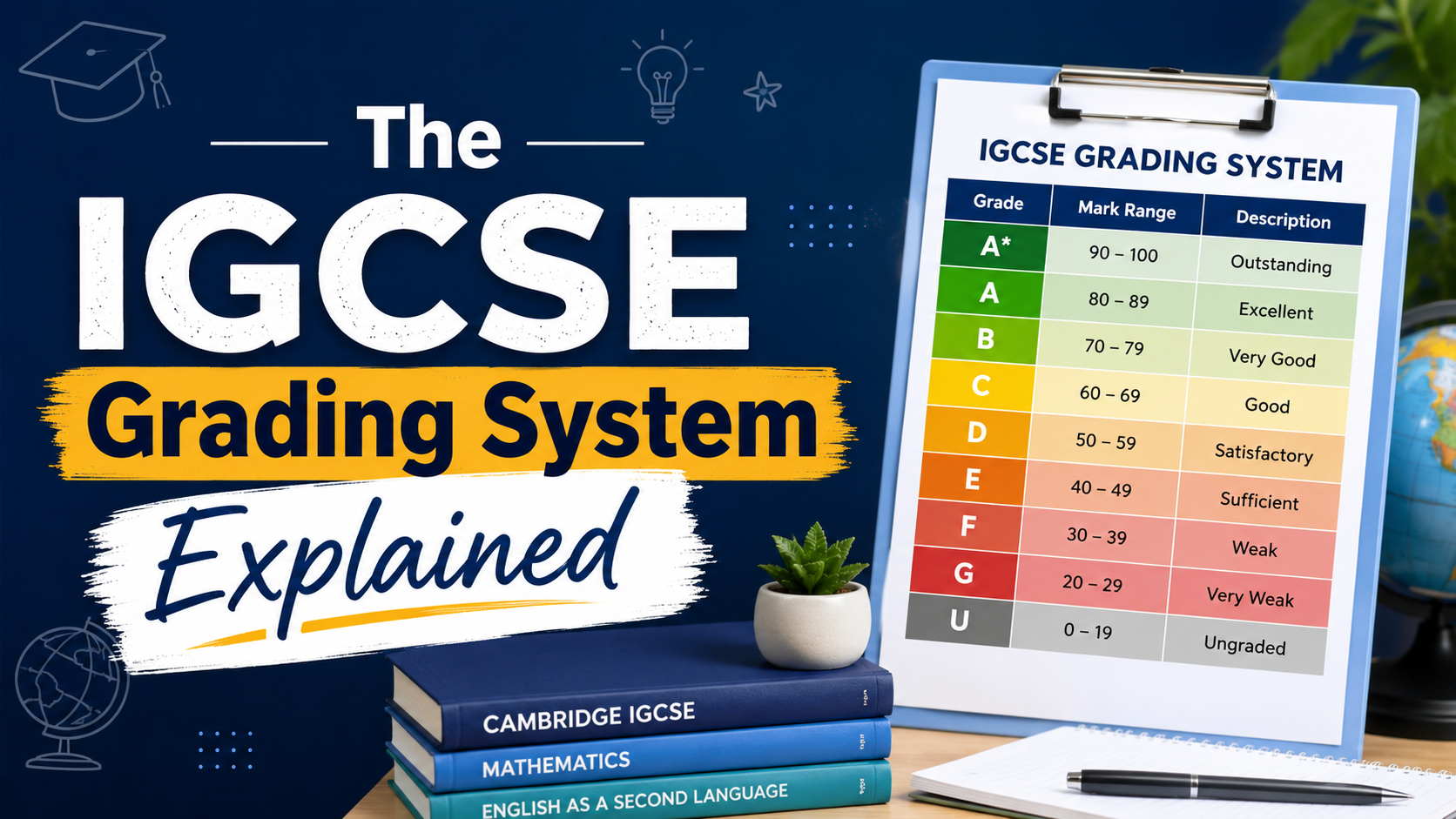
If your child is studying at an international or private school in Malaysia, chances are they're working toward the Cambridge IGCSE. But when results arrive, the letters and numbers can be confusing. Is a C a good grade? Why did the “A boundary” change from last year? What's the difference between A*–G and 9–1? And how does an IGCSE grade compare to SPM?
This guide explains exactly how the IGCSE grading system works, in plain language, and what each grade actually means for your child's next steps.
Cambridge IGCSE grades run A* (highest) down to G, plus U (ungraded). There is no single fixed “pass mark”, grades are set by annual thresholds. C is the practical benchmark for A-Level and university entry. Most Malaysian schools use the A*–G scale, not the 9–1 scale introduced in England.
The International General Certificate of Secondary Education (IGCSE) is the world's most widely taken qualification for 14–16 year olds, most commonly the Cambridge IGCSE awarded by Cambridge Assessment International Education (CAIE). In Malaysia it is the dominant curriculum in international and private schools at Years 10 and 11.
It is recognised by the Malaysian Ministry of Education as equivalent to the SPM for university entry, and by universities across the UK, US, Australia, Canada and beyond. Students typically take seven to ten subjects from a menu of around seventy, assessed through a mix of written exams, practicals and coursework depending on the subject.
The Cambridge IGCSE grading scale runs from A* (the highest) down to G, with U meaning ungraded. That gives eight classified grades plus ungraded.
Higher performing ← → Lower performing
| Grade | What it signals | Typical interpretation |
|---|---|---|
| A* | Highest grade | Outstanding, comprehensive mastery of the syllabus |
| A | Very high achievement | Strong, confident command of the subject |
| B | Good achievement | Above-average performance |
| C | Solid, competent performance | The common benchmark for onward study and university entry |
| D | Sound performance | A classified grade, often below the bar for selective pathways |
| E | Modest performance | Often cited as the minimum classified standard in Cambridge guidance |
| F | Limited performance | A classified grade, but below most progression requirements |
| G | Lowest classified grade | The lowest grade above ungraded |
| U | Ungraded | Performance below the minimum grade threshold |
Cambridge does not use the word “pass” the way SPM does, every grade from A* to G is a classified result, and even D and E are recognised grades rather than fails. In practice, most schools and universities treat C as the key benchmark, and it is the usual minimum for A-Level entry and competitive progression. A U is the only outcome that sits below the grading standard.
A useful nuance: the A* grade is only awarded on a student's overall subject performance, not on individual exam components. In official threshold tables, A* does not exist at the component level, it is calculated across the whole subject.
You may have seen IGCSE results reported as numbers (9 down to 1) rather than letters. Here is the clear version:
Letter grades, the standard at most Malaysian international schools
Numeric grades, used in England and Edexcel iGCSE; less common in Malaysia
| A*–G grade | Approx. 9–1 equivalent | Note |
|---|---|---|
| A* | 9 (with 8 sitting between A* and A) | A* is the top of the top |
| A | 7 | Aligned at this key point |
| B | 6 | 5 sits between C and B |
| C | 4 | Aligned, the common benchmark |
| G | 1 | Lowest classified on both scales |
Universities treat both scales as equivalent, a strong A*–G profile is read the same way as a strong 9–1 one.
This is the part that surprises many parents, and it's worth understanding because it changes how your child should prepare.
IGCSE grades are set by grade thresholds (grade boundaries), not by fixed percentages or quotas. After each exam series, Cambridge sets the minimum marks needed for each grade using examiner judgement and statistical analysis. Because papers vary slightly in difficulty from one series to the next, the boundaries move.
Cambridge also reports a Percentage Uniform Mark (PUM) alongside the grade. The PUM is not the raw percentage your child scored, it shows where within a grade band they landed. It's a helpful signal of how close a student was to the next grade up.
Example: a student graded B, where in the band are they?
A student graded High B is very close to an A, a focused push on technique and past papers could tip them into the next grade.
Because grades turn on thresholds and exam technique as much as raw knowledge, the fastest route from a B to an A is often how answers are written, full working, correct notation and precise, mark-scheme-aligned wording. Practising real past papers against the published mark schemes is one of the most effective things a student can do. Our small-group IGCSE Math and Science programmes are built around exactly this. Book a free trial →
Many IGCSE subjects, Mathematics and the Sciences among them, offer two routes. Choosing the right one matters for your child's grade ceiling:
Covers the essential content. Suitable for students who are consolidating the subject or not targeting the top grades.
Covers additional, more demanding material. The route for students targeting the top grades, A-Levels, IB and competitive universities.
For example, in Cambridge IGCSE Mathematics (0580), students sit either the Core papers (targeting C–G) or the Extended papers (targeting A*–E). Picking the tier that matches the target grade, and preparing properly for it, is a genuine strategic decision, not an afterthought.
The IGCSE tailors assessment to each subject. Understanding the format your child faces is half the battle.
| Subject type | Common assessment formats | What it rewards |
|---|---|---|
| Mathematics (0580, 0606) |
Written papers, calculator and non-calculator | Reasoning, method, accurate working and notation |
| Sciences (Biology 0610, Chemistry 0620, Physics 0625) |
Written theory papers plus a practical or Alternative-to-Practical paper | Concept mastery, precise scientific language, experimental skills |
| Languages | Reading, writing, listening and speaking components | Comprehension and communication across skills |
| Humanities & Business | Written papers, sometimes coursework | Analysis, application, evaluation and case-study skills |
| Computing / ICT | Written papers plus practical tasks | Logic, digital skills, applied problem-solving |
| Creative subjects | Portfolios and practical work | Technique, process and finished outcomes |
For Math and the Sciences specifically, grades hinge on precise, examiner-aligned answers: showing every step in a calculation, using correct units, and phrasing scientific explanations the way the mark scheme expects. These are learnable, trainable skills, which is why two students with similar understanding can finish a grade apart.
IGCSE grades matter most in terms of what they unlock for the next stage of education.
IGCSE (Years 10 and 11) is a stepping stone, not a destination. At around 16, students move into a pre-university programme. In Malaysia, families have an unusually wide choice.
| Pathway | Duration | Assessment style | Best suited to |
|---|---|---|---|
| A-Levels | ~1.5–2 yrs | Exam-focused, deep specialism in 3–4 subjects | Students targeting competitive/UK universities and specific fields |
| IB Diploma | 2 yrs | Broad: 6 subjects plus TOK, EE and CAS; coursework and exams | Well-rounded, independent learners |
| Foundation | ~1 yr | University-specific, continuous assessment and exams | Students set on a particular university or stream |
| AUSMAT / SAM / CIMP / ADP | ~1 yr | Largely coursework and continuous assessment | Students aiming at Australia, Canada or the US |
| Diploma | ~2–3 yrs | Practical, industry-oriented | Career-focused students; can enter degree Year 2 |
For Malaysian families weighing the two systems, here is the short version:
| Feature | Cambridge IGCSE | SPM |
|---|---|---|
| Grading | A* to G, with U for ungraded | A+ to G |
| Curriculum | International, flexible subject choice | National curriculum, more fixed structure |
| Assessment | Written, oral, practical and coursework, depending on subject | Largely final-exam centred |
| Compulsory subjects | Depends on the school and syllabus choices | Bahasa Melayu and Sejarah required for the certificate |
| Typical progression | A-Level, IB, foundation, international universities | STPM, matriculation, foundation, local universities |
| Language of instruction | English throughout | Mix of Bahasa Melayu and English depending on subject |
Neither is simply “better”, they serve different goals. IGCSE suits families wanting an English-medium, internationally portable pathway with flexible subject choice, while SPM remains the national route with its own strong progression options.
The IGCSE is not a niche choice in Malaysia, it is the mainstream international pathway, and demand keeps growing.
Understanding the system points to a clear, practical playbook:
The IGCSE grading system can look complicated, but the logic is fair and consistent: grades reflect a standard of performance, set carefully for each exam series so that students are judged on the same yardstick year to year. Once you understand thresholds, tiers and PUM, you can help your child focus their effort where it counts, on the exam technique and precision that turn understanding into the grade they're capable of.
Brainiac Malaysia runs small-group online IGCSE Math and Science classes led by Singapore- and UK-trained specialist tutors, focused on the mark-scheme mastery and past-paper practice that move students up the grade bands. If you'd like to see how it works, you can book a free trial class.
Small-group classes, under 10 students, taught by Singapore-trained tutors who know the mark schemes inside out.